
Reese Youngblood
(RISD TEXTILES ‘25) is an artist/designer whose work explores the intersection between land, industry, and belonging. She uses textiles—primarily weaving—to express her relationship to herself, the loom, and the Lone Star State.
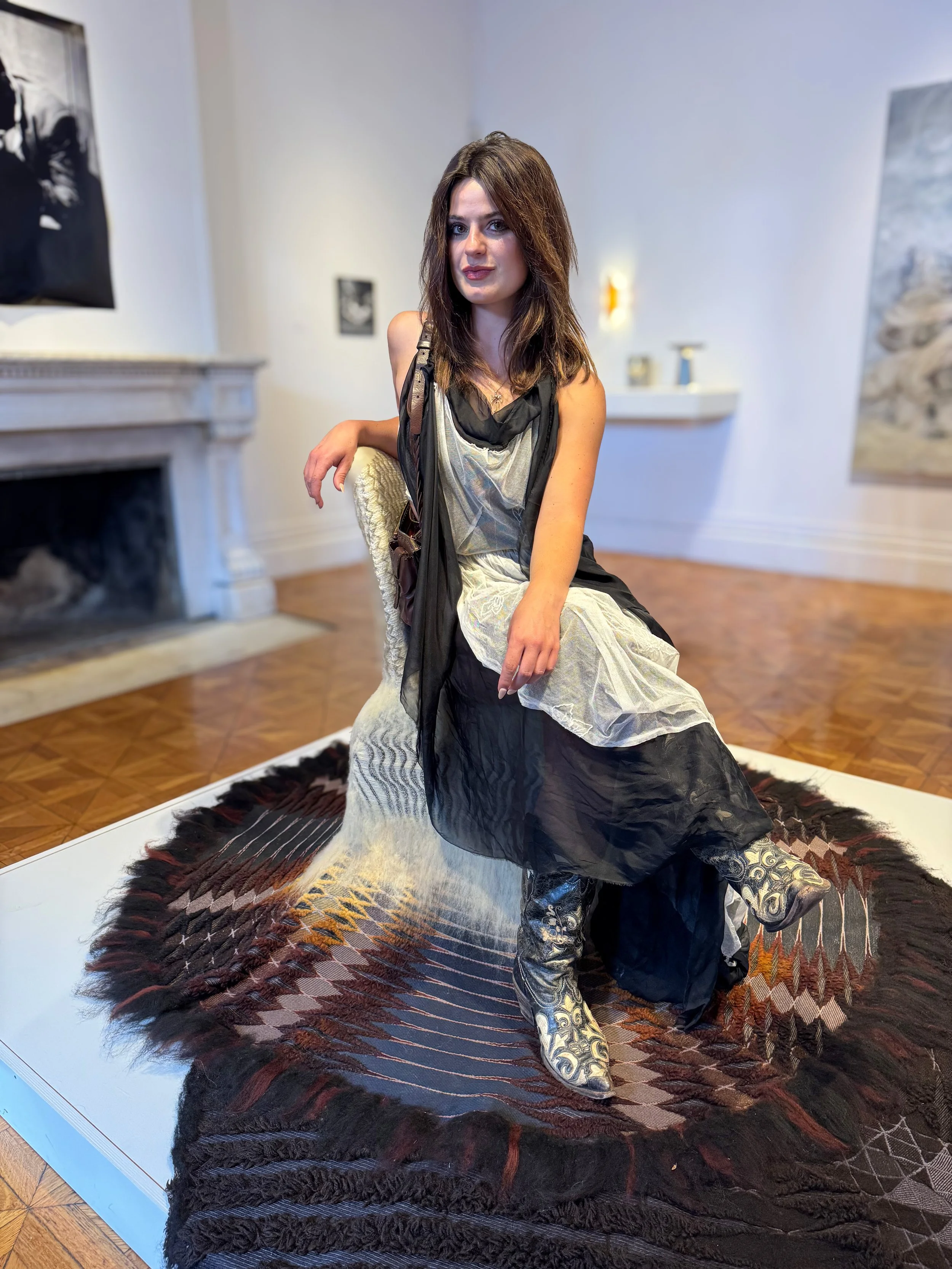
Texas is a loaded place to call home. I have been relying on art to understand what I, for most of my life, have thought to be a cosmic mistake of time and state. Growing up in between Austin and my ranch in Round Top, I remember the constant of looking up to the big Texan sky, convinced that anything was possible. Driving, I would look out the window and marvel at the land’s expanse, its pastures sprawling as county lines became blurred and soft, while political divides starkened. My body started mapping how I felt at these thresholds between city and country––belonging, but also aware of the masculine, conservative agendas that threatened that very sense.
My introduction to textiles as a medium was cathartic. When I arrived at the loom, it showed me quickly how I would have to cooperate with it. I remember the awkward struggle of getting to know its wooden anatomy, but eventually, it was obvious to me that such a foreign piece of equipment could feel like home. Texas, like weaving, has its constraints. It sticks to its politics and big industry and there are aspects about it that frustrate me. At the loom, I feel like I can respond to the way that tension plays out between myself and Texas, working against a new set of rules to tell a story of resistance and belonging.
In my work, I explore the connections between land, body, and surface. Patterns tend to create order, but they can also be elusive, coming in and out of focus, embedding themselves and emerging at once. I am especially fascinated by how patterns operate in nature and how those change with human intervention. I look at the geometries of tire treads, considering how their edges turn soft in the sand. I am fascinated by the forms of manufactured metal, and how rust grows against their surfaces. I translate the tension between natural and artificial into patterns that make their way across fabric, using my body to navigate this terrain.
I aim to leverage my experience as a Texan with a greater quest for making fabrics that complicate, but ultimately enrich our lives. This pursuit can come through with some aggression. I like for the work to reveal certain negotiations I have made in the process––decisions to cut, dye, wash, or felt the fabrics happen often. These choices are not just about control—they are about creating space for friction, for refusal, for the material to push back. Through these exchanges, I hope to prove how textiles can deepen our relation to the world around us, reminding us that surface is never just surface.
I have immense faith in fabric and its empathetic relationship to the human condition.
Between Texas, textiles and myself, a common language is spoken: independent threads submit to the structural authority of the loom, just as my own body submits to the authority of the Lone Star state. In this way, I believe surfaces reveal an exchange between the self and the environment. I imagine that when we encounter them, it is possible to be reminded of how richly we are involved with everything around us, and that is an essential perspective. I strive to make textiles for an increasingly desensitized world, and believe that through surfaces, we can set ourselves up for extraordinary encounters.